

Taino Indian Culture
Puerto Rico's First People
Before Columbus. Before Spain. Before America.
The Taíno shaped Puerto Rico for over 1,000 years—and their legacy lives on today.
Who Where The Taíno?
Imagine Puerto Rico 600 years ago. No cities. No Spanish forts. No highways. Instead: thriving villages of bohíos (thatched houses), ceremonial plazas with stone monuments, and people who had lived in harmony with the island for over a millennium.
These were the Taíno—Puerto Rico's indigenous people who called the island "Borikén" (Land of the Brave Lord).
Taíno Indians, a subgroup of the Arawakan Indians (a group of American Indians in northeastern South America), inhabited the Greater Antilles (comprising Cuba, Jamaica, Hispaniola [Haiti and the Dominican Republic], and Puerto Rico) in the Caribbean Sea at the time when Christopher Columbus' arrived to the New World.
Daily Life & Society
The Taíno Indians lived in theocratic kingdoms and had a hierarchically arranged chiefs or caciques. The Taínos were divided in three social classes: the naborias (work class), the nitaínos or sub-chiefs and noblemen which includes the bohiques or priests and medicine men and the caciques or chiefs, each village or yucayeque had one.
The yucayeques centered around a ceremonial plaza (batey) where the chief's house stood facing the batey. Villages ranged from 100 to 5,000+ people, depending on the cacique's power.
The naborias lived in round huts, called bohios. The construction of both types of building was the same: wooden frames, topped by straw, with dirt floors, no partitions between families and scant interior furnishing. Buildings were strong enough to resist hurricanes. Its believed that Taíno settlements ranged from single families to groups of 3,000 people. Several related families lived together in the same house.
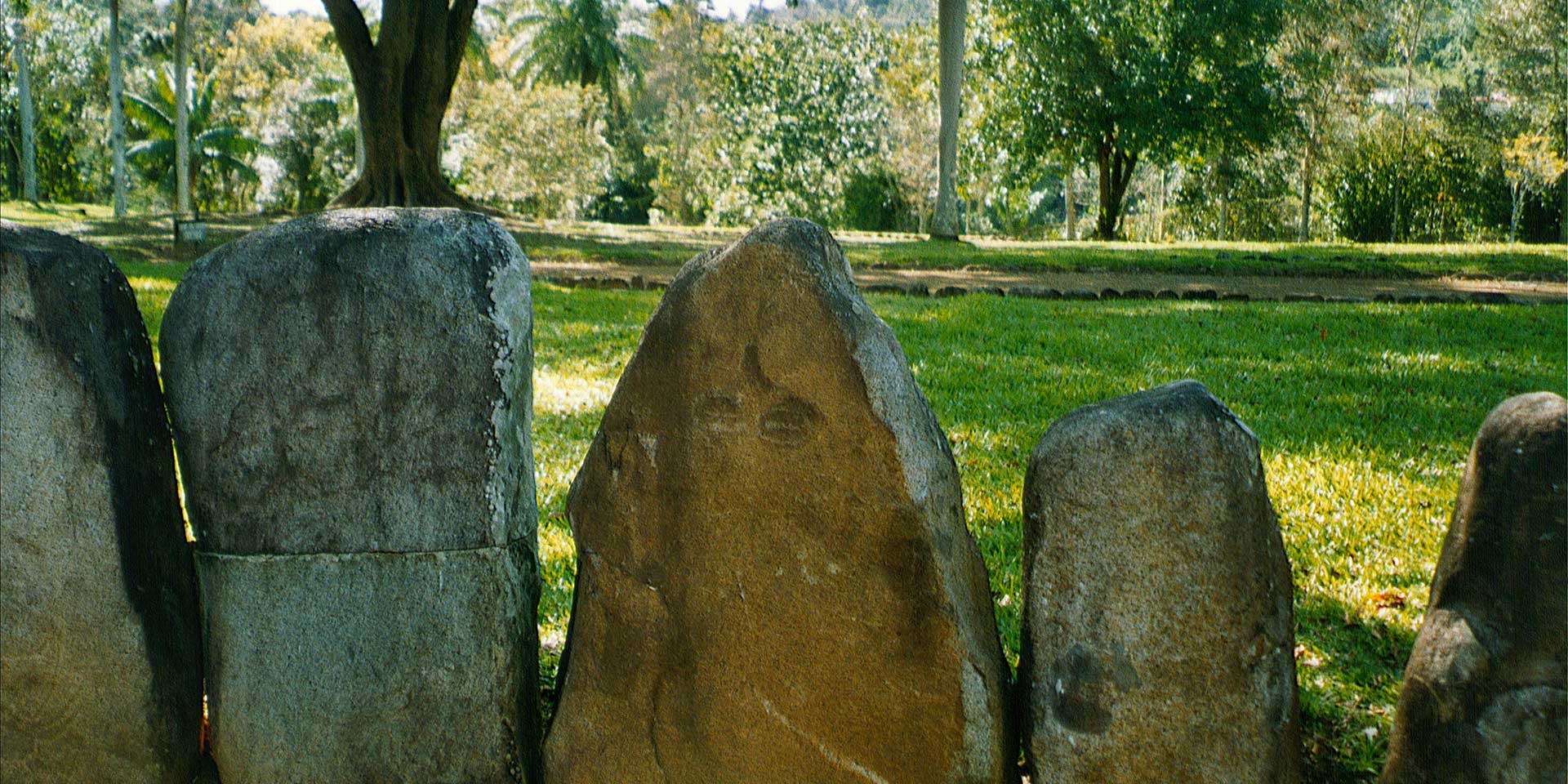
The Taíno culture impressed both the Spanish (who observed it) and modern sociologists. The Arawakan achievements included construction of ceremonial ball parks whose boundaries were marked by upright stone dolmens, development of a universal language, and creation of a complicated religious cosmology.
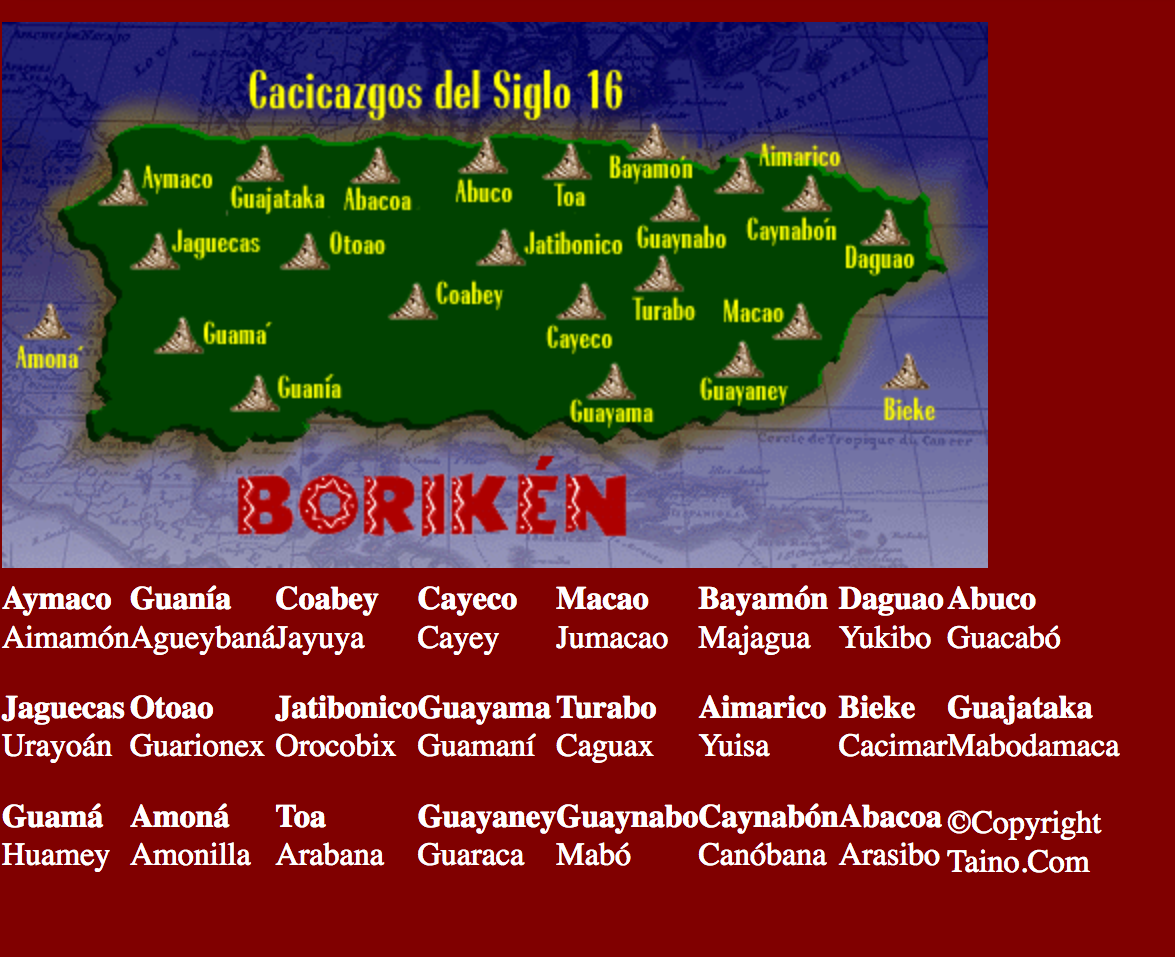
At the time Juan Ponce de León took possession of the Island, there were about twenty yucayeques (villages), Cacique Agüeybana, was chief of the Taínos. He lived at Guánica, the largest Indian village in the island, on the Guayanilla River. The rank of each cacique apparently was established along democratic lines; his importance in the tribe being determined by the size of his clan, rather than its war-making strength. There was no aristocracy of lineage, nor were their titles other than those given to individuals to distinguish their services to the clan. Both men and women were eligible to serve as chiefs. Individuals traced their descent through their mothers, and goods, class status and the office of chief were also inherited matrilineally.
Polygamy was practiced. Men, and sometimes women, might have several spouses. A few caciques had as many as 30 wives, in most instances they were the only ones who could afford it.
Their complexion were bronze-colored, average stature, dark, flowing, coarse hair, and large and slightly oblique dark eyes. Men generally went naked or wore a breech cloth, called nagua, single women wore headbands and walked around naked and married women an apron to cover their genitals, made of cotton or palm fibers. The length of which was a sign of rank. Both sexes painted themselves on special occasions; they wore earrings, nose rings, and necklaces, which were sometimes made of gold. Taíno crafts were few; some pottery and baskets were made, and stone, marble and wood were worked skillfully.
Social Structure
The cacique was the chief and highest-ranking leader within Taíno society, ruling over a yucayeque, or village territory. Leadership was typically hereditary and most often passed from father to son, although Taíno society was unique in that power could also be inherited through the female line. The most powerful caciques governed multiple villages and held significant political, military, and spiritual influence.
- Cacique - Chief/Leader
- Bohique - Shaman/Spiritual Leader
- Nitainos - Noble Class/Warriors
- Naborias - Common People
- Naboria-Daca - Lowest Class/Servant
Famous Caciques
- Agüeybaná - Supreme cacique of Puerto Rico
- Guarionex - Powerful Hispaniola leader
- Anacaona - Female cacique (yes, women could rule)
Religion & Beliefs
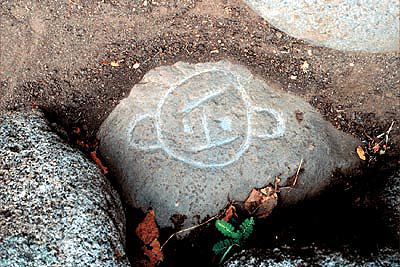
Photo: Ignacio Rivera
There was a hierarchy of deities who inhabited the sky; Yocahu was the supreme Creator. Another god, Jurakán, was perpetually angry and ruled the power of the hurricane. Other mythological figures were the gods Zemi and Maboya. The zemis, a god of both sexes, were represented by icons in the form of human and animal figures, and collars made of wood, stone, bones, and human remains. Taíno Indians believed that being in the good graces of their zemis protected them from disease, hurricanes, or disaster in war. They therefore served cassava (manioc) bread as well as beverages and tobacco to their zemis as propitiatory offerings. Maboyas, on the other hand, was a nocturnal deity who destroyed the crops and was feared by all the natives, to the extent that elaborate sacrifices were offered to placate him.
Myths and traditions were perpetuated through ceremonial dances (areytos), drumbeats, oral traditions, and a ceremonial ball game played between opposing teams (of 10 to 30 players per team) with a rubber ball; winning this game was thought to bring a good harvest and strong, healthy children.
Taino Creativity & Innovation
Skilled at agriculture and hunting, Taínos were also good sailors, fishermen, canoe makers, and navigators. Their main crops were cassava, garlic, potatoes, yautías, mamey, guava, and anón. They had no calendar or writing system, and could count only up to twenty, using their hands and feet. Their personal possessions consisted of dujo or dujo wooden stools with four legs and carved backs, hammocks made of cotton cloth or string for sleeping, clay and wooden bowls for mixing and serving food, calabashes or gourds for drinking water and bailing out boats, and their most prized possessions, large dugout canoes, for transportation, fishing, and water sports.

About 100 years before the Spanish invasion, the Taínos were
challenged by an invading South American tribe - the Caribs
![[Glos.]](../images/glos.gif) . Fierce, warlike, sadistic, and adept at
using poison-tipped arrows, they raided Taíno settlements for slaves
(especially females) and bodies for the completion of their rites of
cannibalism. Some ethnologists argue that the preeminence of the
Taínos, shaken by the attacks of the Caribs, was already jeopardized by
the time of the Spanish occupation. In fact, it was Caribs who fought the most
effectively against the Europeans, their behavior probably led the
Europeans to unfairly attribute warlike tendencies to all of the island's
tribes. A dynamic tension between the Taínos and the Caribs certainly
existed when the Christopher Columbus landed on Puerto Rico.
. Fierce, warlike, sadistic, and adept at
using poison-tipped arrows, they raided Taíno settlements for slaves
(especially females) and bodies for the completion of their rites of
cannibalism. Some ethnologists argue that the preeminence of the
Taínos, shaken by the attacks of the Caribs, was already jeopardized by
the time of the Spanish occupation. In fact, it was Caribs who fought the most
effectively against the Europeans, their behavior probably led the
Europeans to unfairly attribute warlike tendencies to all of the island's
tribes. A dynamic tension between the Taínos and the Caribs certainly
existed when the Christopher Columbus landed on Puerto Rico.
The Arrival of Columbus
When the Spanish settlers first came in 1508, the Taíno initially welcomed the Spanish with gifts and hospitality. At their arrival the Spaniards expected the Taíno Indians to acknowledge the sovereignty of the king of Spain by payment of gold tribute, to work and supply provisions of food and to observe Christian ways.
The Taínos rebelled most notably in 1511, when several caciques (Indian leaders) conspired to oust the Spaniards. They were joined in this uprising by their traditional enemies, the Caribs. Their weapons, however, were no match against Spanish horses and firearms and the revolt was soon ended brutally by the Spanish forces of Governor Juan Ponce de León.
Since there is no reliable documentation, anthropologists estimate their numbers to have been between 20,000 and 50,000, but maltreatment, disease, flight, and unsuccessful rebellion had diminished their number to 4,000 by 1515; in 1544 a bishop counted only 60, but these too were soon lost.
The Myth of Extintion
For centuries, history books claimed the Taíno were "extinct." This was false.
While their civilization was destroyed, Taíno people survived through:
- Fleeing to mountains (Jíbaros)
- Intermarriage with Spanish and Africans
- Hiding their identity for safety
- Preserving traditions in secret
Modern genetic studies show:
- 61% of Puerto Ricans have Taíno mitochondrial DNA
- Especially common in mountain regions
- More prevalent than previously thought
Taino Legacy
In order to understand Puerto Rico's prehistoric era, it is important to know that the Taínos, far more than the Caribs, contributed greatly to the everyday life and language that evolved during the Spanish occupation. Taíno place names are still used for such towns as Utuado, Mayagüez, Caguas, and Humacao, among others.
Many Taíno implements and techniques were copied directly by the Europeans, including the bohío (straw hut) and the hamaca (hammock), the musical instrument known as the maracas, and the method of making cassava bread. Many Taino words persist in the Puerto Rican vocabulary of today. Names of plants, trees and fruits includes: maní, leren, ají, yuca, mamey, pajuil, pitajaya, cupey, tabonuco and ceiba. Names of fish, animals and birds includes: mucaro, guaraguao, iguana, cobo, carey, jicotea, guabina, manati, buruquena and juey. As well as other objects and instruments: güiro, bohío, batey, caney, hamaca, nasa, petate, coy, barbacoa, batea, cabuya, casabe and canoa. Other words were passed not only into Spanish, but also into English, such as huracan (hurricane) and hamaca (hammock). Also, many Taíno superstitions and legends were adopted and adapted by the Spanish and still influence the Puerto Rican imagination.
Where to Experience Taino Heritage Today
Explore Puerto Rico's Indigenous Heritage
Museums with Taino Collections
- Museo de Arte de Ponce
- Museo de Historia, San Juan
- UPR Museum of Anthropology
- Museo del Indio, Jayuya
Frequently Asked Questions
Where can I learn about the Taíno people?
Several sites interpret Puerto Rico's Indigenous history, including the Tibes Indigenous Ceremonial Center in Ponce and the Caguana Indigenous Ceremonial Park in Utuado. These archaeological sites preserve ceremonial plazas, petroglyphs, and artifacts that offer insight into Taíno culture before European arrival.
I think this structure transforms the page from a simple list of places into a guide that explains why these sites matter and helps visitors decide which ones fit their interests. It also complements the style you've established on your newer pages like Kids Activities, Golf, and Restaurants.
Books
- The Tainos: Rise and Decline of the People Who Greeted Columbus
- The Indigenous People of the Caribbean
- In Defense of the Indians : The Defense of the Most Reverend Lord, Don Fray Bartolome de las Casas, of the Order of Preachers, Late Bishop of Chiapas
- The Tainos: Rise & Decline of the People Who Greeted Columbus
Other Resources
- Genographic Project DNA Results Reveal Details of Puerto Rican History
- Arawaks
- Cacicazgos del Siglo 16 (Source: http://taino.com/PR/tainos/mapacaciques.html)
- Caciques, Nobles, and their Regalia
- Indigenous Puerto Rico: DNA evidence upsets established history
- The Jatibonicu Taino Tribal Nation
- The New Old World - Antilles: Living Beyond the Myth.
- Tainos
Did You Know?
The park protects part of Puerto Rico's unique karst landscape, a region characterized by limestone hills, caves, sinkholes, and underground rivers.
This is your comprehensive guide to La Isla del Encanto.


